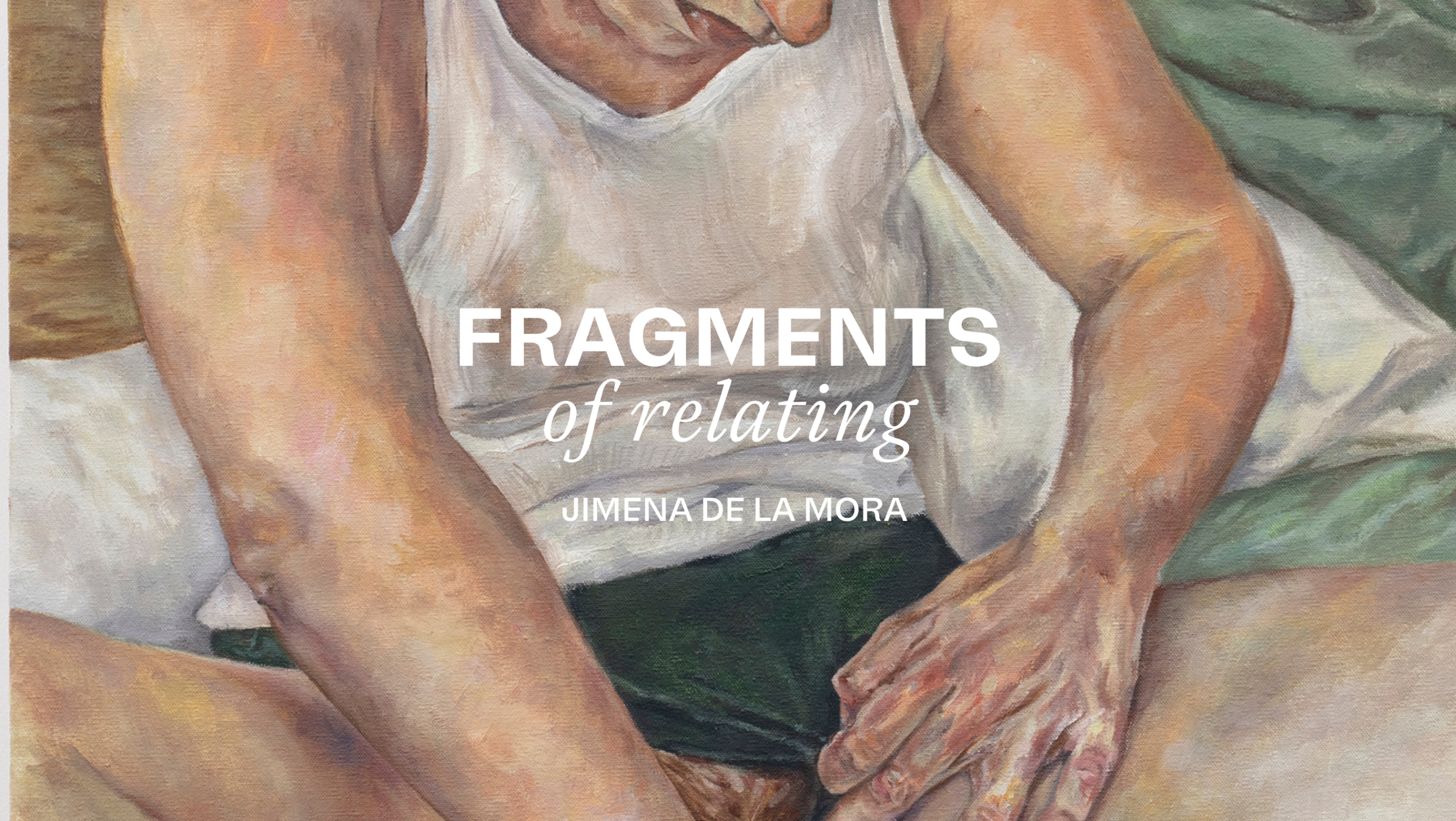
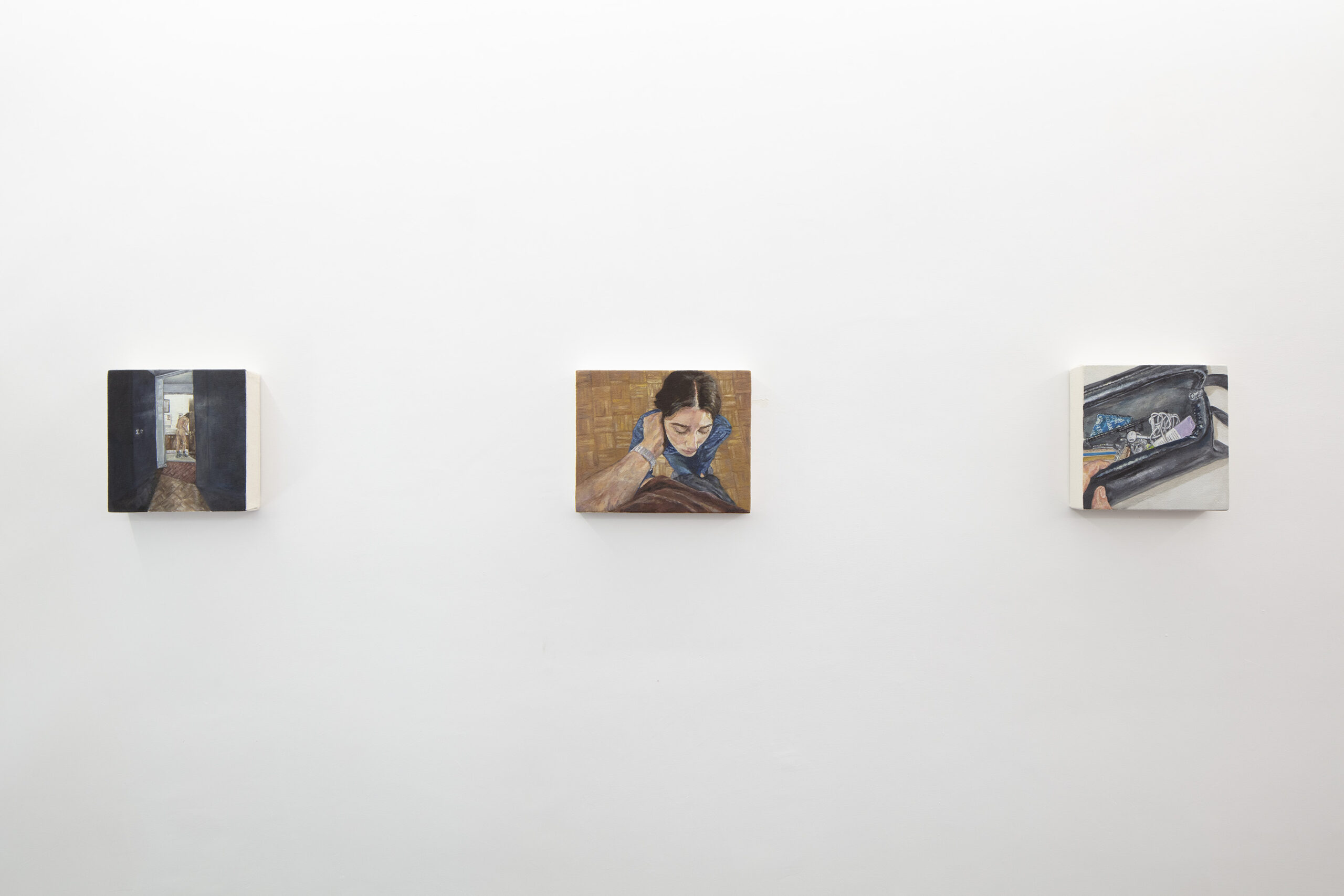
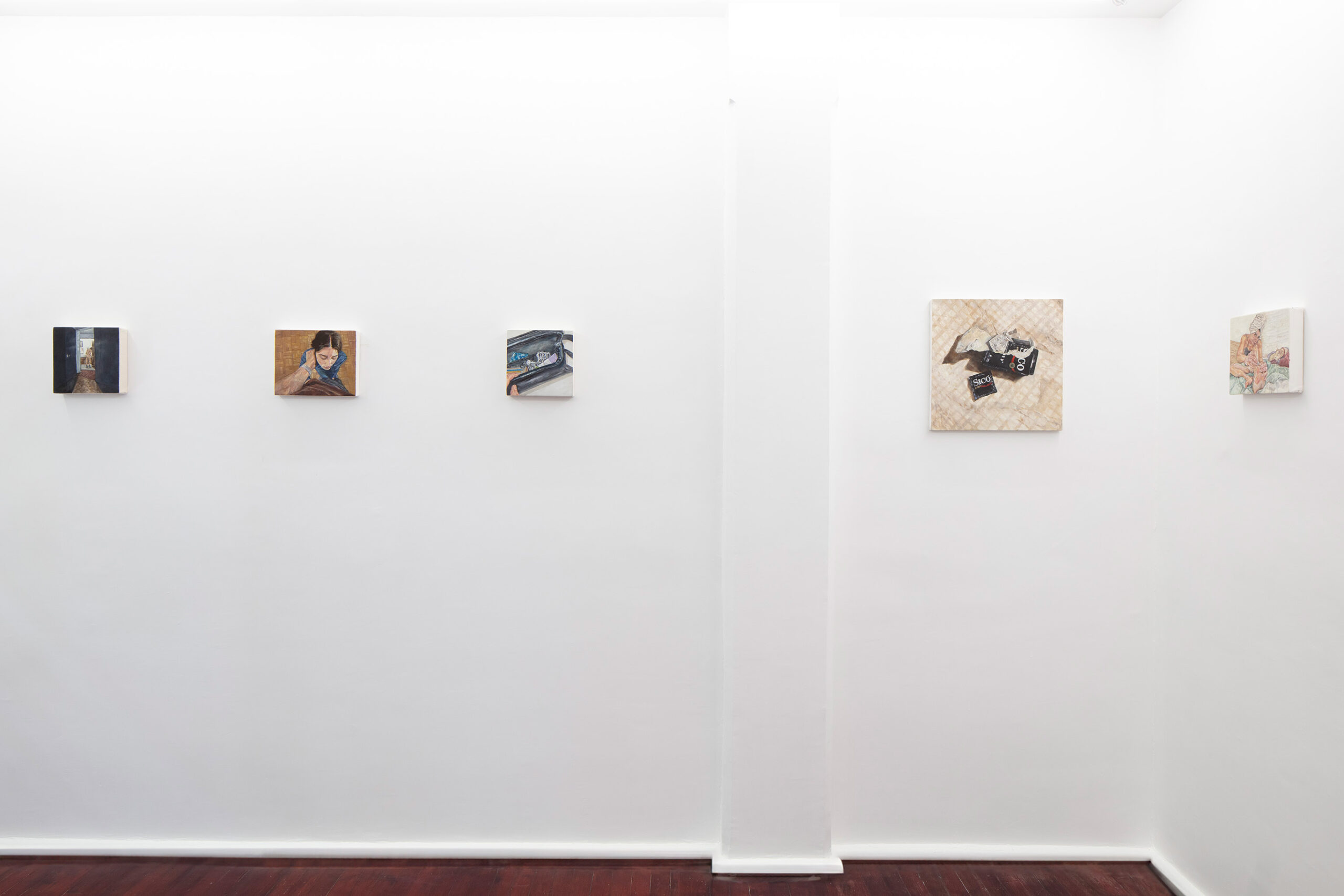
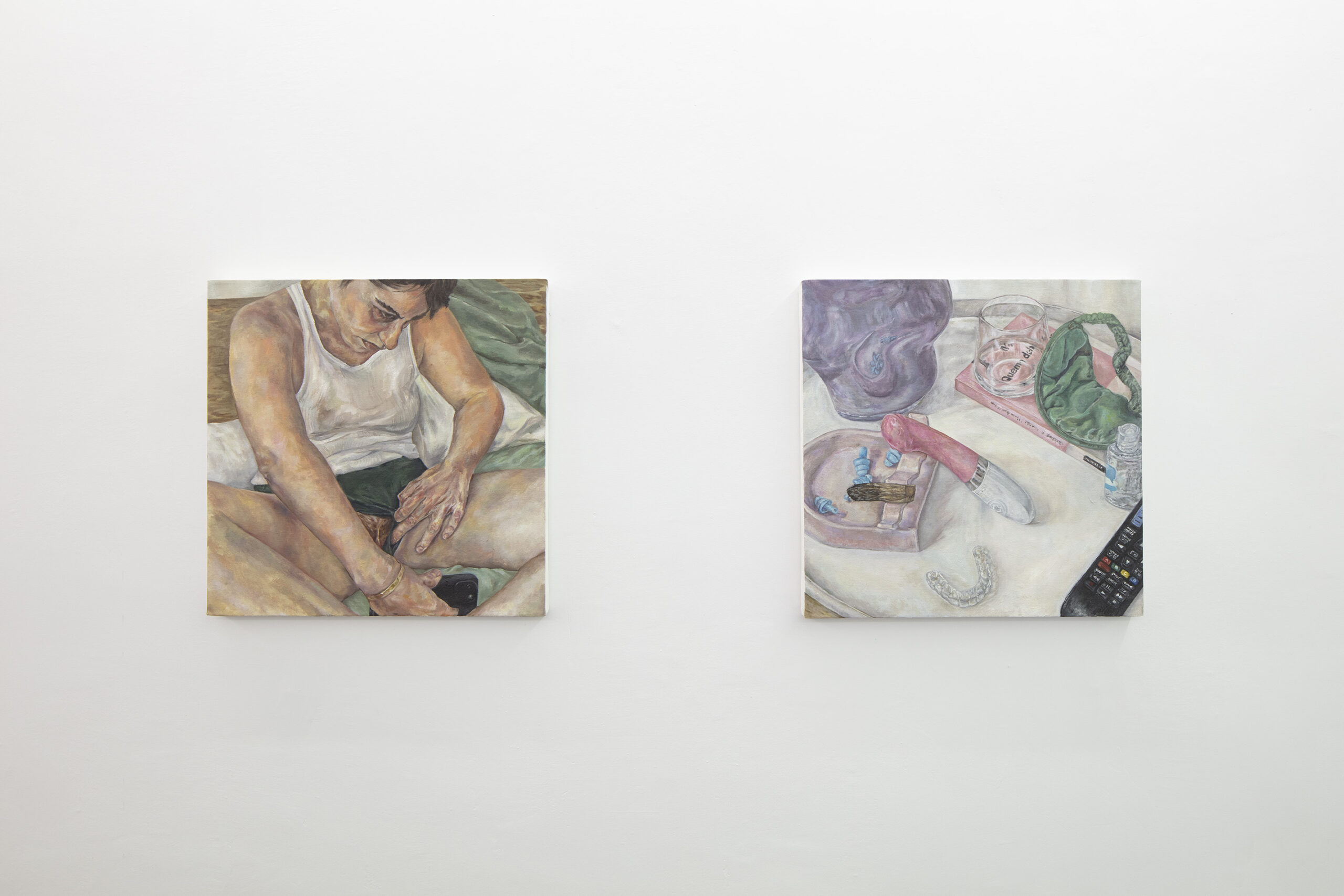
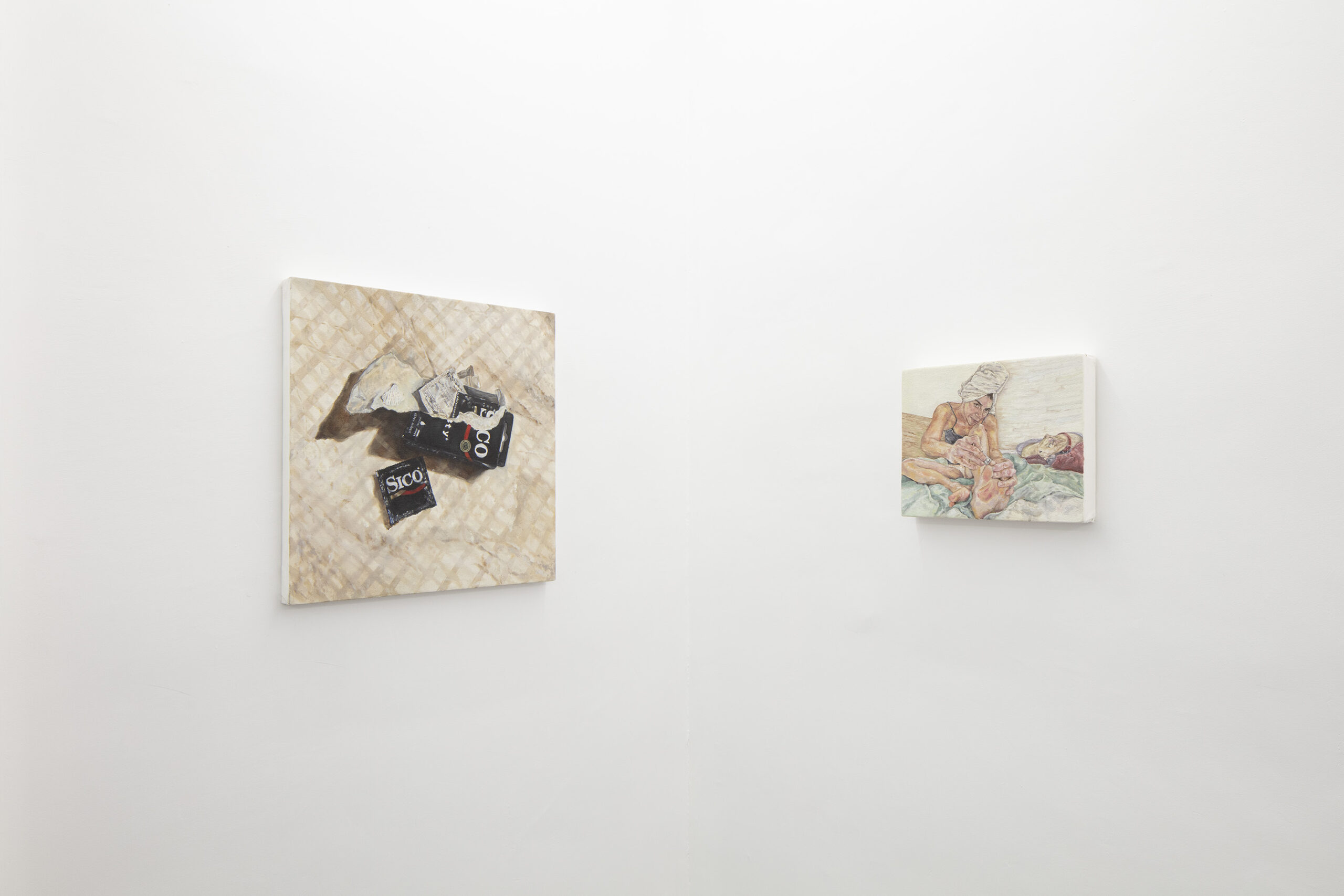
Within this tension between inheritance and contemporaneity, painting remains central yet becomes increasingly entangled with personal history and a subtle but persistent dialogue with the immediacy, voyeuristic gaze, and performance of the everyday inherent to social media. The pieces borrow, whilst simultaneously challenging, not just compositions but behaviors from the digital. The cropped frame, the close-up that implies touch, the casual staging that is anything but accidental. In a translation of intimacy and relational dynamics into image, a nightguard sits next to a vibrator and lube; a lover’s hand is rendered with the tenderness of brush and memory; and a candid portrait mirrors the angle of a photograph snapped while reclining in bed. Painterly tradition, in this sense, becomes a point of departure.
Generating a sense of presence, de la Mora’s paintings record lived moments and act as witnesses of a life as it unfolds, with all its inconsistencies and vulnerabilities. Working through an expanded notion of self-portraiture, she constructs a form of humanity that resists resolution: bodies, gestures and set-ups feel immediate and narrative. Her paintings thus echo the psychological presence of Alice Neel, whose portraits hold their subjects in similar states of uneasy revelation; the slow and sustained attention of Lucian Freud, in whose works flesh is rendered with a material and psychological depth that resists idealization; the dense physicality of Jenny Saville’s works in which flesh becomes a site of weight and sensation; and the diaristic intimacy of Tracey Emin, whose pieces reflect a confessional immediacy and deep seated emotional candor. These affinities function as shared sensibilities or approaches to figuration that privilege vulnerability over control, and presence over perfection.
Inseparable from lived experience, de la Mora’s relational trajectory –spanning varied romantic experiences, emotional entanglements, and blurred senses of self– forms an undercurrent throughout the work. One that has led to the emergence of her painting practice as a kind of visual diary through which meaning surfaces retrospectively. The painting usually understands before the artist, permitting her to navigate periods of emotional strain, creative blockage, and displacement. What emerges is thus a layered account of intimacy constructed through the implications put forth by objects, gestures, and environments. The works invite us to piece together narratives from details, much like scrolling through someone’s personal archive. They also insist on point of view: the artist’s spaces, home, objects, and relationships take center stage. From this vantage point, intimacy is defined as something mediated and continually redefined by the space between experience and representation, presence and projection, what is felt and what is seen.
Exploring the intrinsic instability of intimacy, the paintings in FRAGMENTS OF RELATING suggest that relating is shaped by both the oscillation between private and public, and the passage of time. They ask us to look again, to discover what springs forth from the space between desire, memory, and identity, and to question our own habits of seeing. Tracing varied cartographies of relating, the works explore the possibility of intimacy beyond prescribed forms while also acknowledging the persistence of dissonance and renegotiation; not only in how de la Mora relates to others but also in how she experiences emotional proximity. Painting, in this sense, becomes a space to hold the tension between closeness and distance, tenderness and violence, autonomy and entanglement.